The Park Shore Beach Walk Isn't One Project. It's Six.
August 13, 2026
August 13, 2026
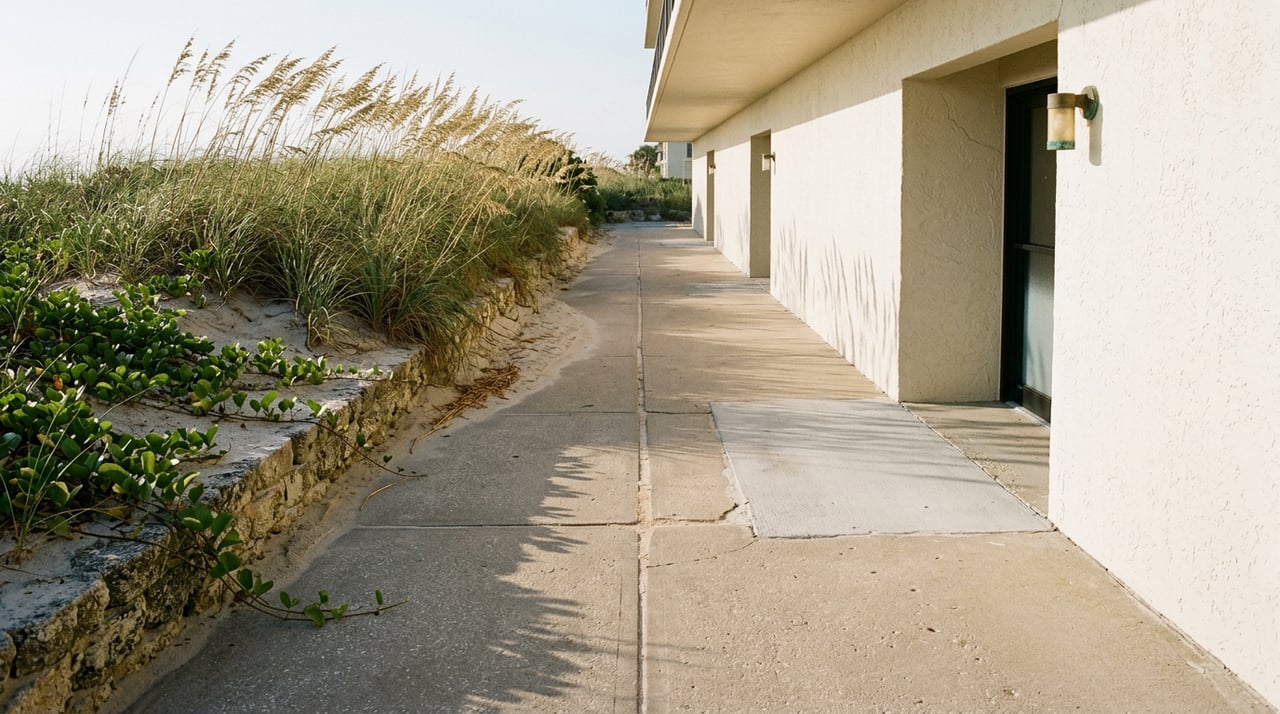
Walk the Park Shore promenade on a Saturday morning and you'll notice something odd if you pay attention. The pavers under your feet change character every few hundred yards. One stretch feels freshly poured, edges crisp, signage new. The next stretch feels older, worn at the joints, a bench missing where you'd expect one. Most people chalk this up to normal wear. It isn't. It's the visible seam between six different owners, each moving on its own schedule, each answering to its own board.
That's the story behind the 1.2-mile beach-walk that runs along Gulf Shore Boulevard North from Horizon House on the south end to LeParc on the north. As the Gulf Shore Association of Condominiums documents, the Lutgert Company built the walk in the early 1970s, and for more than 50 years it held up without incident. Nearly 2,000 condominium owners along the corridor rely on it as their front door to the Gulf. Then Hurricane Ian arrived in 2022 with a 14-foot storm surge, and the concrete that had survived five decades of ordinary weather did not survive that.
What happened next is the part most write-ups skip. The walk isn't a single asset with a single owner writing a single repair check. It's divided among five separate Commons associations, each holding its own stretch of pavement and its own board, plus a completely separate, single-owner park sitting in the middle of the corridor. Understanding that split explains everything about why some sections look finished and others don't, and why the biggest project on the table, raising the whole promenade against future storms, is still being studied years after the storm that made it necessary.
By February 2024, the recovery picture already showed the pattern. According to a GSAC update from that month, three of the five Commons associations that jointly comprise the walk, Commons R, T/U, and V, had reinstalled their "Private Beach Walk, No Trespassing" signs, the same signs that spell out the walk's longstanding rules against bikes, dogs, and skating. Commons S, covering the stretch between Gulfside and La Mer, had signs on order. Commons W, between the Vistas and LeParc, was still meeting to decide its next move.
The same update noted new benches at the south end of the walk, replacing ones lost to the storm surge. North of the Park Shore Association's own Beach Park, there were still no places to sit.
None of that is a criticism of any single board. It's a description of how the walk actually works. Five separate legal entities, five separate maintenance budgets, five separate decision-making calendars, one continuous surface under everyone's feet. A resident walking north to south isn't crossing a construction zone. They're crossing five different jurisdictions.
Two years later, GSAC's own April 2026 report still describes the promenade in the language of an active resiliency effort, not a finished one. That's not a delay story. It's the operating model, working exactly as its structure dictates.
The reason the walk hasn't simply been rebuilt as it was is that nobody wants it rebuilt as it was. According to a 2025 progress update from the Park Shore Association, the promenade in front of the PSA beach park sat at roughly six feet of elevation at the time of that report. The proposal on the table would more than double that height by building a substantial berm topped by the walkway itself.
The case for doing it isn't theoretical. The same PSA update points to sections that were already built higher and came through Hurricanes Helene and Milton with meaningfully less damage than lower stretches nearby. That's the evidence driving support for the project, not a general sense that higher is safer, but a specific before-and-after from two recent storms.
Here's the part that explains the timeline. A project like this can't be approved with one vote at one board meeting. It requires five separate Commons boards, each representing a different legal owner of a different parcel of concrete, to agree on a shared design, a shared cost split, and a shared construction schedule. PSA Board President Nancy Walkenhorst has been sitting in on the Commons meetings specifically to keep the two ownership structures aligned as the framework develops. A February 2025 update from PSA put it plainly: if the berm project is approved, it would not be ready before 2026. As of this summer, it's still a study, not a shovel.
That's the bottleneck. Not the engineering, which is largely settled. Not the money, which the storm comparisons make a fairly clear case for. The bottleneck is governance: six owners, one shared surface, one decision that has to hold across all of them at once.
While the walk waits on six-way consensus, the piece of ground sitting in the middle of that same corridor keeps checking items off its list, because it only answers to one board.
The Raymond L. Lutgert Beach Park, a 200-foot, 2.7-acre private beachfront park donated to the Association by the Lutgert family in 1978, is owned outright by the Park Shore Association. No neighboring Commons has a vote in what happens there. That single-owner structure is exactly why its project list has kept moving while the walk's headline berm project sits in study.
Collier County's Coastal Zone Management Department led a native dune revegetation project along the beach fronting the five Commons properties, using sea oats and other native grasses, completing the initial planting in June 2024 with a 180-day establishment period. A year later, PSA planted again. By February 2026, the Association was reporting that the newer dune plantings, installed the previous summer, were thriving.
The rest of 2026's early calendar tells the same story of a single board simply acting. At the February 12, 2026 annual meeting, the Association gave longtime advocate Jo Ann Smallwood a lifetime membership in recognition of more than four decades of work on behalf of the park. A Wine Wednesday gathering was set for March 18, timed to a 7:38 p.m. sunset. An Easter Egg Hunt followed on April 4. Facility upgrades and parking procedures for peak season were addressed in the same run of newsletters.
None of that required alignment across five boards. It required one board saying yes. That's the difference in plain terms: the park has a landlord, the walk has a committee.
A few practical takeaways follow from understanding the corridor this way, whether you've lived here for years or you're new to the block.
Don't read pavement condition, signage, or bench availability as a single verdict on "the walk." Read it as a map of which Commons has acted and which hasn't. The variation is the system working as designed, not a sign anyone is behind.
If the berm project clears its remaining hurdles, expect it to arrive commons by commons rather than as one continuous lift on a single date. Each board controls its own segment and its own construction schedule, and there is no single entity with authority to move all five at once.
The Beach Park's own progress, the dune plantings, the facility upgrades, the steady calendar of events, is the closest thing available right now to a preview of what a rebuilt, elevated walk might eventually look like. It's the one piece of this system with a single decision-maker, which is exactly why it keeps finishing things.
Park Shore rewards this kind of attention. The small print on how its private amenities are actually governed rarely makes it into the glossy version of the story. Knowing which board owns which stretch of pavement, and why, is the kind of detail that turns a daily walk into an informed one.
If you're weighing a move within Park Shore, working through what a specific stretch of that promenade means for a property you're considering, or simply want a local read on how these overlapping associations affect day-to-day living, Coastal Living Naples is glad to walk through it with you. Schedule Your Free Consultation whenever you're ready to talk specifics.
Stay up to date on the latest real estate trends.

Get assistance in determining current property value, crafting a competitive offer, writing and negotiating a contract, and much more. Contact her today.
Angela Graziano is a Naples, Florida real estate agent serving buyers and sellers throughout Naples, FL and nearby Southwest Florida communities including Bonita Springs, Estero, Fort Myers, and Marco Island.
Naples, FL
Looking for a real estate agent in Naples, FL or the surrounding Southwest Florida area? Angela provides a clear strategy, strong negotiation, and an organized contract-to-close process.